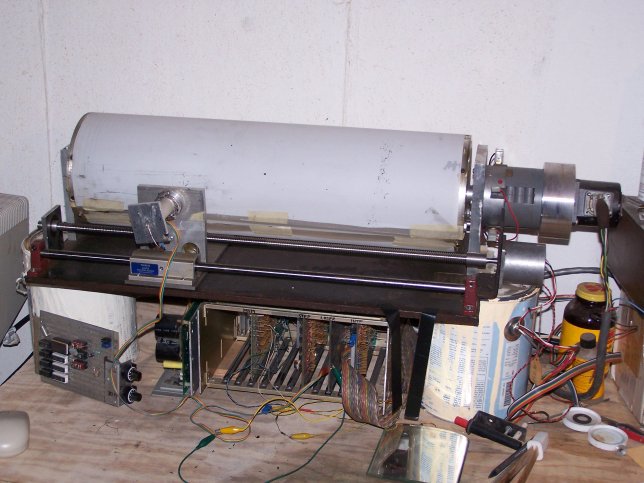
I have built a machine that plots images on photographic film. I started out wanting to make photographic master artwork for printed circuit boards, but also had ideas of making grey-scale prints and scanning artwork. The scanning function is now available at the local computer store, so I'm glad I didn't spend any time working on that. but the other two functions are now working. Anyway, the photoplotter has a 6.519" diameter drum (circumference = 20.480") which is 20" long. It is rotated at 10 rev/sec by a motor, and it's rotation is monitored by a 1024 line shaft encoder. A digital PLL multiplies 1024 pulses / rev by 20 to get 20480 pulses / rev which equals 1 pulse per .001" of circumference (which works out to 20.480". A stepper motor moves a carriage along the drum .001" every rotation. The optical head focuses the beams from a 670 nM Laser diode through a 13 mm FL lens onto red-sensitive high-resolution film. The unit exposes film at the rate of .01"/sec, or .6"/minute in the axis parallel to the drum.
General view of the Photoplotter. Drum drive motor and encoder are at upper right. Stepper motor is al lower right. Optical carriage is now at left edge of drum. Note film attached to left part of drum with masking tape.